


🏛️ Regulation & Insider Trading: Positioning Before Enforcement
Kalshi CEO Tarek Mansour publicly stated support for proposed legislation that would ban government officials from trading on prediction markets.
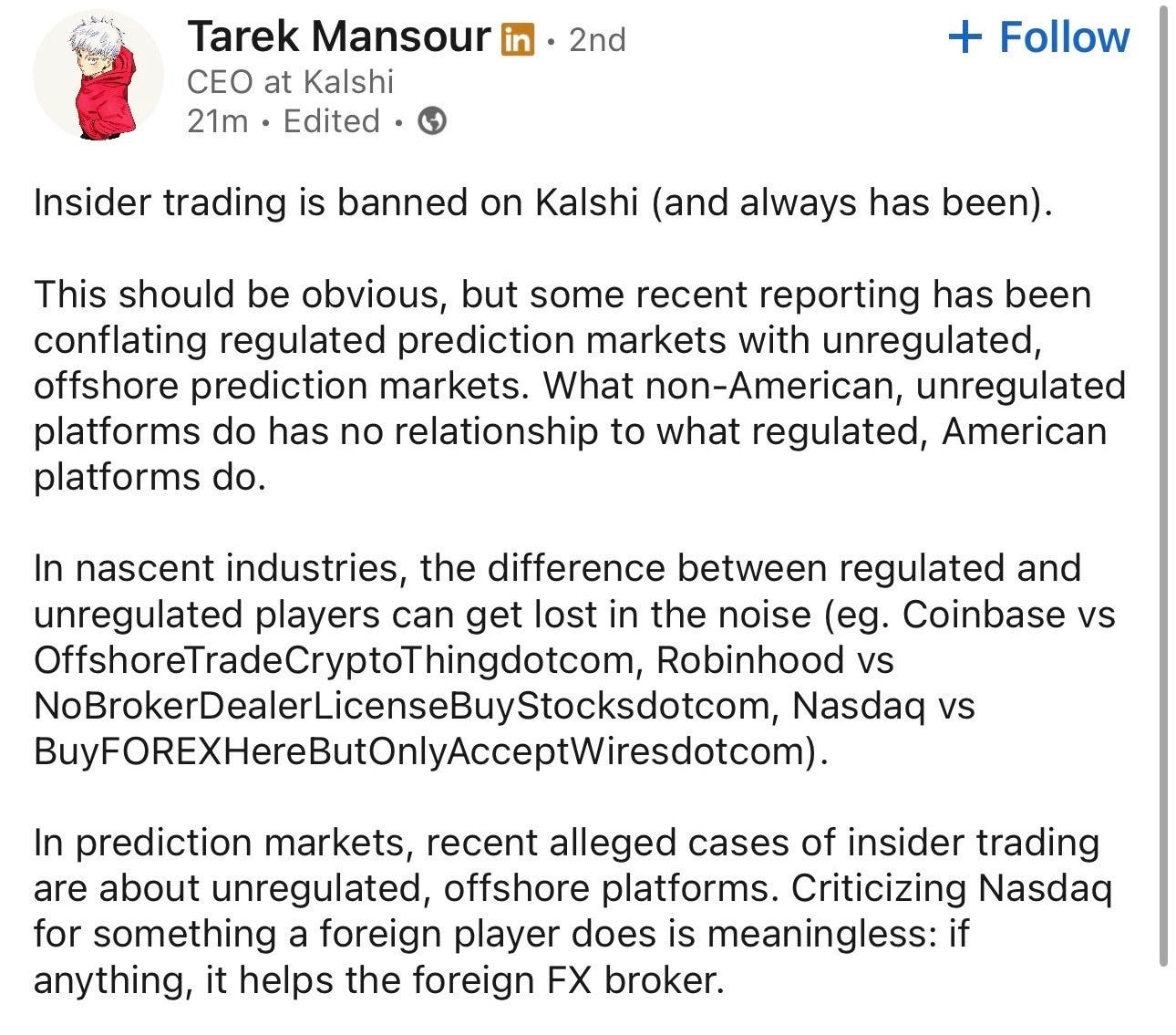
The move aligns with Kalshi’s status as a fully regulated U.S. venue, where KYC enables rule enforcement — at least in theory. The broader insider trading debate remains unresolved across prediction markets, particularly on permissionless platforms where enforcement is structurally infeasible.
Recent high-profile trades linked to geopolitical events in Venezuela reignited scrutiny, reinforcing that:
Insider participation remains a core information vector for prediction markets
Regulation primarily affects who may participate, not whether informational asymmetry exists
This debate is now less about morality and more about regulatory optics ahead of broader U.S. market access.
🤝 Polymarket’s Partnership Blitz Accelerates
Polymarket announced a string of exclusive partnerships in rapid succession:
Official & exclusive prediction market partner of the New York Rangers
Exclusive prediction market partner of The Wall Street Journal and Dow Jones
Exclusive prediction market partner of the Golden Globes

These partnerships mirror Kalshi’s earlier CNN and CNBC integrations, signaling a shared strategy: co-citation with trusted institutions rather than short-term user incentives.
The economic structure of these partnerships remains undisclosed. Regardless of who pays whom, the strategic objective is clear:
Normalize prediction markets as information infrastructure
Embed market probabilities directly into media and cultural moments
Shift perception from “betting product” to signal layer
This positions prediction markets alongside — not against — legacy media narratives.
📈 Crypto on Kalshi: Fast Growth, Small Share
Crypto is now the second-largest category on Kalshi, posting 40% month-over-month growth. Despite that, crypto still represents only ~2.5% of total volume, with sports exceeding 90%.
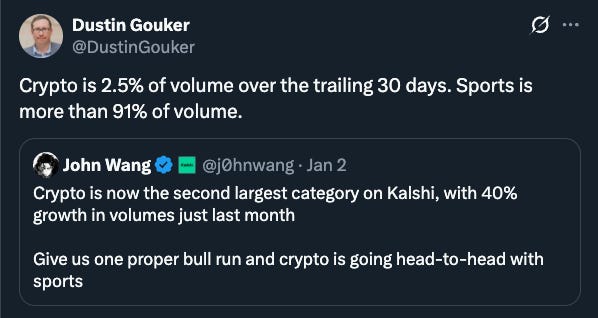
Key takeaways:
Growth rate is strong
Absolute contribution remains marginal
Sports liquidity continues to dominate regulated venues
Kalshi also introduced 15-minute crypto markets, aligning with a broader industry shift toward short-duration contracts.
💸 Fees Are Back: Polymarket Tests Monetization
Polymarket appears to be introducing fees up to 3%, currently applied to 15-minute crypto up/down markets.
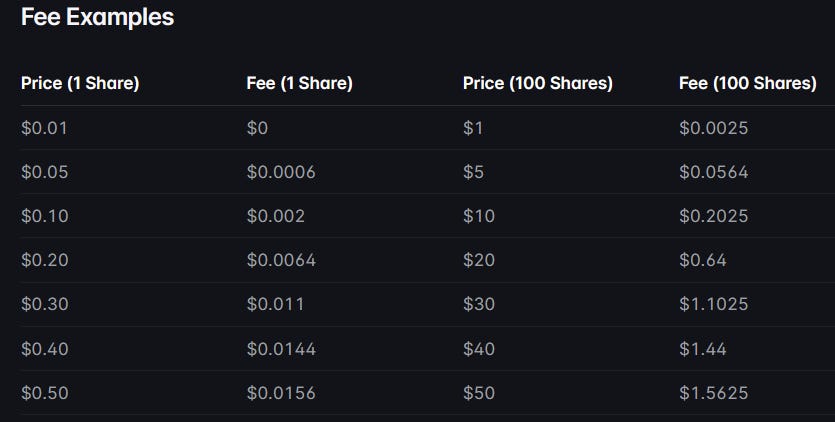
A newly surfaced fee schedule confirms:
Fees are market-specific
Network/validator costs remain separate
Total transaction cost is not yet fully transparent
This marks a shift from pure growth mode toward sustainability. The open question is elasticity:
Professional traders are highly fee-sensitive
Competing platforms may respond aggressively
Past NFT marketplace fee wars suggest pricing pressure and competition are inevitable.
📊 Volume Records vs Reality
Kalshi posted a new daily notional volume ATH (~$400M) and announced $100B in annualized volume.
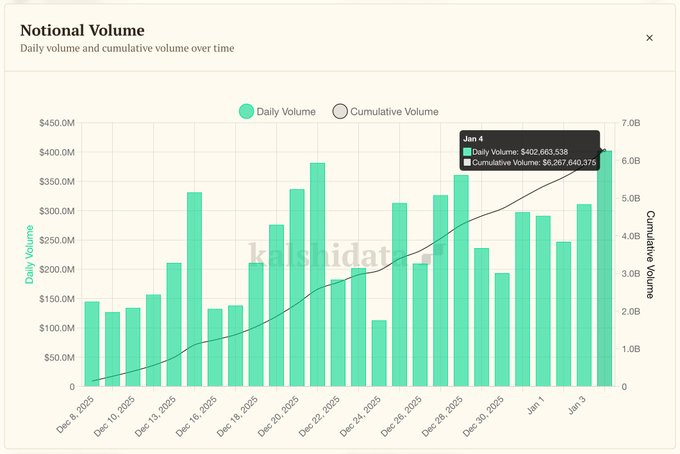
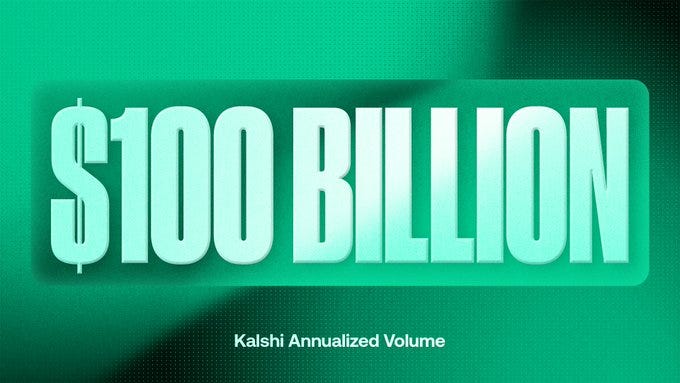
Two interpretations coexist:
Volume has surged materially since the NFL season
Annualizing a short-term spike is an aggressive extrapolation
Context:
Lifetime Kalshi notional volume ≈ $27B
Sports seasonality materially distorts short-term metrics
The headline achieved reach. The metric achieved attention. Neither directly reflects sustained activity.
⚔️ Prediction Markets vs Pump.fun
Last week marked the closest gap yet between prediction market volume and Pump.fun activity — though Pump.fun still processed roughly 4× more volume.
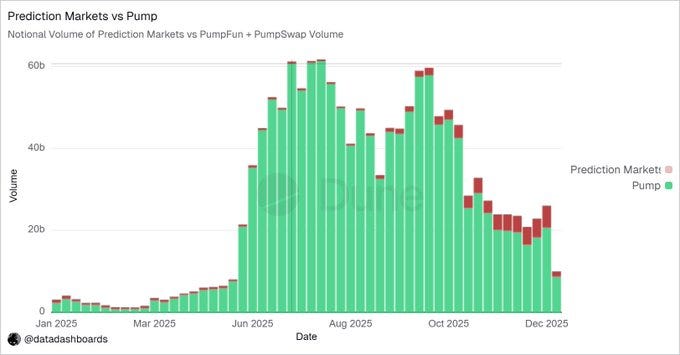
The comparison is imperfect but useful:
Both are retail-driven crypto consumer products
Both compete for speculative attention
Prediction markets remain meaningfully smaller
This frames the current ceiling for prediction market engagement.
💵 Who Trades Bigger?
Data comparing average bet sizes shows:
Prediction market users wager 2–3× more per trade than regulated sportsbook users
Comparable or higher than offshore sportsbooks
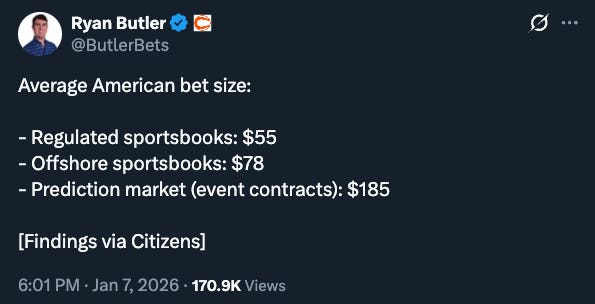
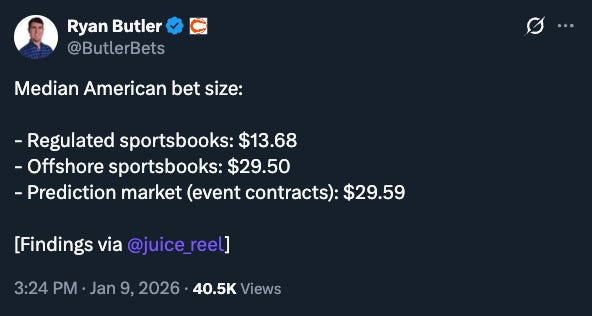
Interpretation caveats:
Smaller user base inflates averages
Whales skew distributions
Regulated sportsbooks actively limit high-skill bettors
Still, the data suggests higher conviction per user within prediction markets.
Long-Tail Markets Are Not So Small
Notably:
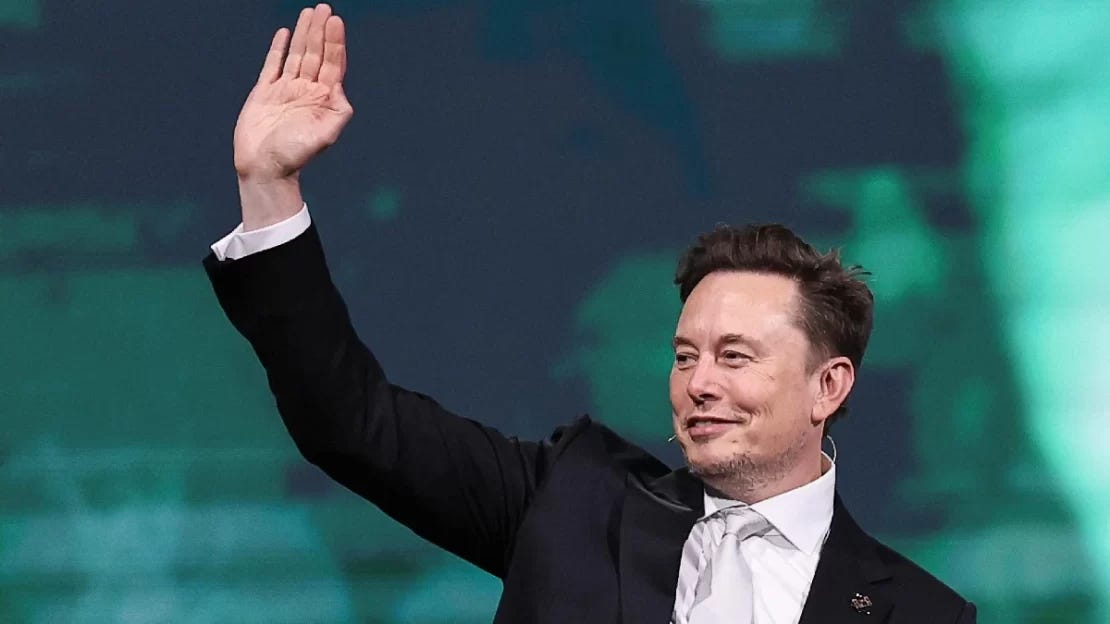
1.5% of Polymarket’s all-time volume comes from markets tied to Elon Musk’s tweeting behavior
One week alone saw ~$16M in volume on that single market category
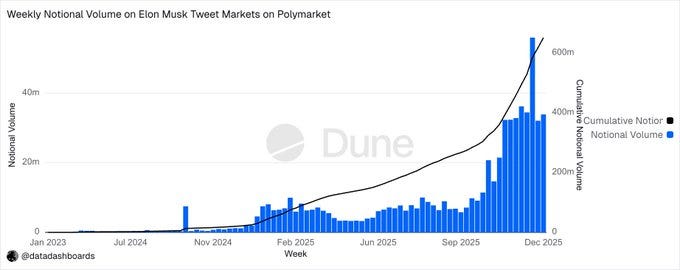
These “cultural constant” markets outperform many standalone crypto applications.
Research Meets Markets

Delphi Digital partnered with Polymarket to convert predictions from its Year Ahead report into live markets.
This model:
Forces analysts to put probabilistic forecasts on-chain
Enables real-time performance tracking
Blurs the line between research and accountability
It may become a template for future analyst-driven markets - which we would like to see.
Bottom Line
Prediction markets are no longer proving demand — they are negotiating legitimacy, pricing power, and narrative control.
The next phase is not about launching markets.
It is about sustaining liquidity, surviving regulation, and converting attention into durable infrastructure.
We're past experimentation.
Now comes the stress test.
📬 BEFORE YOU GO — SUBSCRIBE, FOLLOW, WATCH
Follow @DollarTrade on X
And subscribe to the newsletter
Join our livestream on Mon and Thur at 8:30 EST.
Thanks for riding with us!