



🎯 The Market That Priced the U.S. Strike on Iran
When news broke of U.S. strikes on Iran, prediction markets had already moved.
Polymarket odds had significantly shifted before mainstream confirmation, reinforcing the narrative that markets aggregate dispersed information faster than traditional media.
But one trade stood out.
An account reportedly turned $87,000 into roughly $500,000, placing a large position about 71 minutes before the news became public.

This reignited the recurring debate:
Was this insider trading?
Was it satellite analysis and open-source intelligence?
Or simply a well-informed but legal inference?
Prediction markets operate in a grey zone between public data aggregation and material non-public information. The transparency of blockchain transactions makes suspicious activity visible, but not necessarily provable.
The episode underscores a broader industry need for:
Clear definitions of material non-public information
Surveillance frameworks
Enforcement mechanisms
Without these, accusations will continue to surface in high-impact geopolitical markets.
On the other hand, we don't ignore the role of insider trading on prediction markets.
⚖️ “Death Markets” and Kalshi’s Resolution Controversy
Following developments around Iran’s Supreme Leader, Kalshi closed a related market under a special rule rather than resolving it Yes or No.

The backlash was immediate.
Critics labeled it a “death market” controversy. Kalshi's CEO pointed out that the resolution mechanism was clearly stated in the contract rules.
One counterargument well pointed that almost any market can indirectly relate to death.
If a star athlete dies, sports markets are affected.
If a CEO dies, equity markets move.
The issue is not whether death is involved, but whether resolution rules are:
Transparent
Predefined
Consistently enforced
In prediction markets, credibility rests on contract clarity.
An article titled “Prediction market bets on Iran strikes stoke insider trading, ethics scrutiny” highlighted ethical concerns around profiting from geopolitical conflict.
Meanwhile, opinion pieces argued that war markets are not inherently immoral, they are mechanisms for aggregating expectations.
The core tension:
Are these markets exploitative?
Or are they informational tools reflecting collective belief?
As prediction markets move into geopolitics, the moral conversation will likely grow louder.
🏦 Nasdaq Files to Launch a Prediction Market
In a major signal for institutional adoption, Nasdaq reportedly filed to launch its own prediction market product.

If successful, this would mark:
Traditional exchange infrastructure entering event contracts
Increased regulatory legitimacy
Greater capital inflows
Prediction markets are increasingly viewed not as novelty betting tools, but as information markets with pricing power.
As Nick Preszler stated, “Nasdaq's move into prediction markets should give us an preview of what ICE will be launching with Polymarket”.
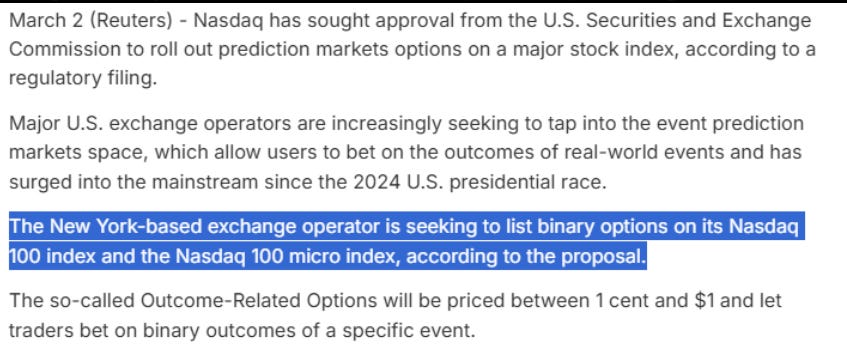
Institutional interest suggests the category is transitioning from fringe to financial infrastructure.
📊 Monthly Data Recap: Volume Keeps Climbing
A new monthly recap from Dash highlighted continued growth across major platforms.

Key takeaways:
Kalshi led in notional volume, roughly 20 percent ahead of Polymarket
Polymarket recorded significantly more transactions, suggesting broader retail participation
Spot trading volumes across prediction markets are reportedly up 29x year over year

The divergence between higher notional volume on Kalshi and higher transaction count on Polymarket points to different user profiles, larger average ticket sizes versus higher retail frequency.
As U.S. regulatory clarity improves, the competitive dynamic between these two platforms will likely intensify.
🧩 The Token vs Equity Debate
This week, we had a pretty interesting conversation with Johnny from Prospect Markets, a publicly traded company in Canada building in the prediction markets space. That discussion reignited a fundamental structural debate:
Should prediction market platforms issue tokens, equity, or both?
Key tensions:
Tokens create short-term price volatility pressure
Equity structures introduce disclosure, regulatory cost, and capital constraints
Hybrid models risk misaligned incentives between token holders and shareholders
Some builders argue that tying product perception to token price can damage long-term credibility. If the token chart looks bad, user confidence can collapse, regardless of product quality.
As the industry matures, capital structure design may prove as important as market design.
For a full breakdown of the topic, check out our conversation from our last live:


On War Markets - Read
Prediction Markets Without Liquidity Providers - Read
Kalshi, Polymarket Under Fire For War-Related Trades After U.S. Iran Strike - Read
Thousands of Amateur Gamblers Are Beating Wall Street Ph.D.s - Read
How I'd Become a Quant If I Had to Start Over Tomorrow - Read
📬 BEFORE YOU GO — SUBSCRIBE, FOLLOW, WATCH
Follow @DollarTrade & our editor on X
Subscribe to the newsletter and share it with a friend
Join our livestream on Tue and Thur at 8:30 EST.
Thanks for riding with us!