


Prediction markets are entering their next phase
Prediction markets are no longer a niche corner of crypto or finance. Over the past weeks, they crossed three boundaries at once: distribution (wallets), legitimacy (media), and scrutiny (regulation). Together, these shifts force a harder question into the open:
👉 Are prediction markets financial infrastructure — or just gambling with better UX?
This edition breaks down what actually changed, why it matters, and where the real fault lines are ⚖️

💬 For a deeper dive into these topics, check out yesterday’s live stream featuring Aggie and Andrew Courtney, where wallets, media accountability, regulation, and the “truth engine vs casino” debate were discussed in detail.
🎓 Prediction Markets, Explained (and Why This Matters Now)
A short explainer video circulating this week did something important: it explained prediction markets in simple words.
At the core, a prediction market is simple:
📈 People buy and sell outcomes of future events
🎯 Prices represent probabilities
🔄 Markets update as new information appears
Why this matters: prices combine money + belief + information into one signal. Unlike polls or pundits, markets force participants to put capital behind their views 💸
That single constraint changes behavior — and accuracy.
You can check it out here.
👛 The Kalshi × Phantom Announcement: Distribution Is the Real Breakthrough
Kalshi’s integration with Phantom Wallet is the most important structural development this month.

Why?
Because distribution beats features 🚀
Phantom brings millions of users. Kalshi brings regulated event contracts. The result: prediction markets embedded directly where crypto users already operate — no new accounts, no onboarding friction, no extra steps.
This follows a clear pattern:
Kalshi → Phantom
Polymarket → MetaMask
Myriad → Trust Wallet
Prediction markets are no longer destinations. They’re becoming native wallet features 🔌
Historically, markets win by removing steps. This is the same shift trading made from desktops to mobile apps. 📱
📰 Media + Markets: From Opinions to Receipts
Legacy media is quietly changing how it handles uncertainty.
Partnerships between prediction markets and outlets like CNN and CNBC point to a shift:
From forecasts to probabilities
From opinions to prices
From confidence to accountability
The key difference: receipts. A pundit can be wrong forever with no cost. A market position records:
what was predicted
when it was predicted
how much conviction existed
whether it paid off
That creates a public track record. Over time, audiences can tell who sounds confident versus who is consistently right ✅
Prediction markets may not replace journalism — but they can become “the antidote to unaccountable news forecasting”, as Aggie says.
🎰 Truth Engine or Casino?
This debate is no longer academic.
Two real critiques surfaced this week:
Are prediction markets just gambling?
Do all markets provide social value?
The answer isn’t binary.
🧠 Where prediction markets clearly add value
Elections
Interest rate decisions
Economic indicators
Corporate outcomes
These markets:
Aggregate dispersed information
Influence real-world decisions
Improve forecasting accuracy
⚠️ Where things get messy
Word-count (“mention”) markets
Pop-culture outcomes
Events controlled by a single actor
These are fun — but fragile. When one person can influence the outcome directly, the signal degrades. The market becomes less about forecasting reality and more about gaming incentives.
The real distinction isn’t “financial vs fun.” It’s information quality vs manipulation risk.
For a deep dive into this matter check out Andrew Courtney's article “Prediction Markets: Truth Engine or Casino? A Scoring Framework.”
🏈 Sports Contracts, Gambling, and the CFTC Fight
A new survey claims 85% of Americans view sports contracts as gambling, not financial instruments.
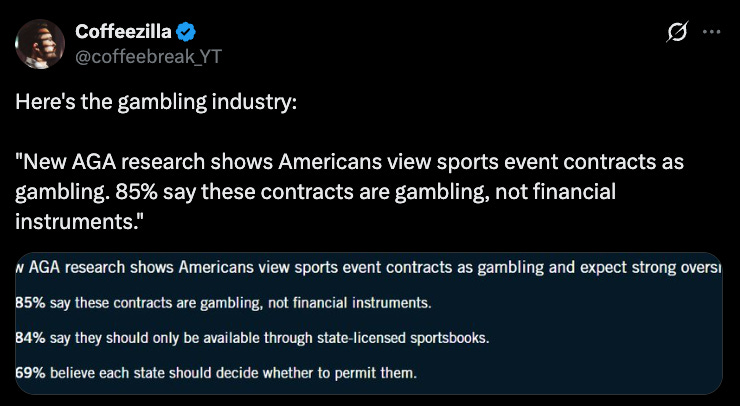
Regulators and incumbents lean into that framing — but the structural counterpoint matters:
Prediction markets:
Are peer-to-peer
Have no house setting odds
Allow early exit
Show transparent price discovery
That’s fundamentally different from sportsbooks.
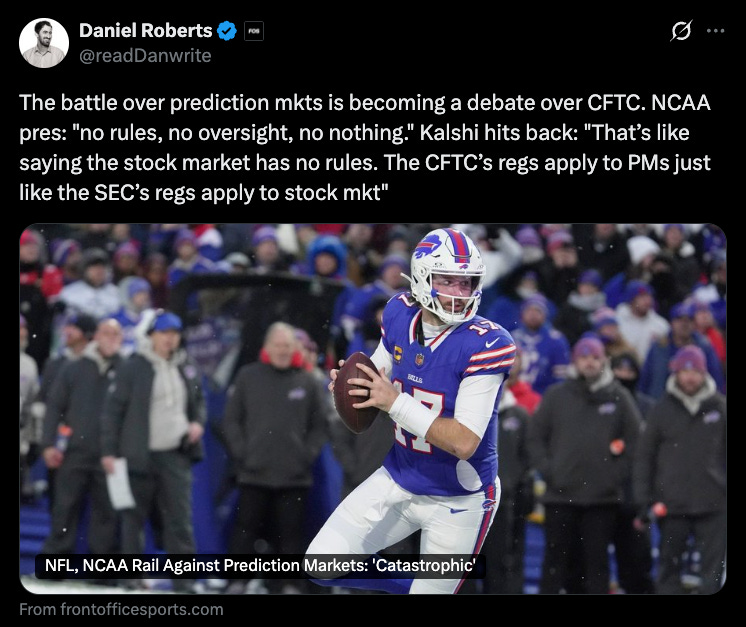
But the real fight isn’t moral — at least in the U.S., it’s legal:
Sportsbooks are regulated state by state
Prediction markets are federally regulated (CFTC)
Expect this conflict to escalate ⚔️
🧩 What Actually Makes a “Good” Prediction Market?
Three conditions consistently matter:
Broad participation 👥
Many independent actors with different information
Hard-to-manipulate outcomes 🔒
No single actor controls resolution
Clear settlement rules 📝
No ambiguity at expiration
Markets that meet these criteria converge toward accuracy. Markets that don’t produce low-quality signals whose outcomes can’t be trusted as forecasts.
This distinction will likely shape future regulation — even if regulators never say it explicitly.
🔭 Where This Is Headed
Three trends look locked in for next year:
Wallet-native prediction markets 👛
Media using markets as validation layers 🧠
Clear separation between serious markets and entertainment 🎭
Prediction markets aren’t replacing finance, media, or betting.
They’re forcing each to answer a harder question:
👉 Why should your forecast be trusted?
That alone makes them impossible to ignore.
📬 BEFORE YOU GO — SUBSCRIBE, FOLLOW, WATCH
Follow @DollarTrade on X
And subscribe to the newsletter.
Thanks for riding with us!